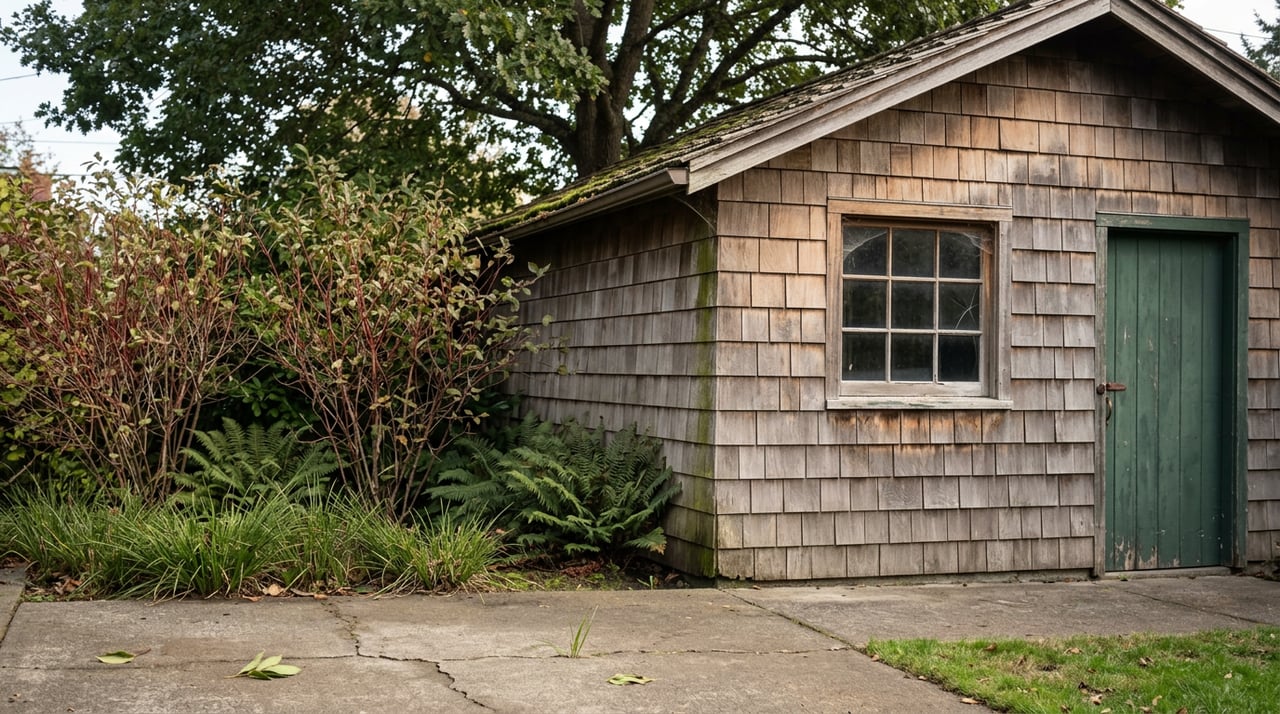
Walk the back half of almost any older Mill Valley lot along Sutton Manor Creek or the lower stretch of Old Mill Creek and you'll likely find the same thing: a detached garage or small outbuilding, built decades before anyone was thinking about accessory dwelling units, sitting closer to the property line or the creek bank than anything the city would let you build there today. For years that garage was just a garage. In 2026, it might be the single most valuable structure on the property, and not because of what it's worth as a garage.
The reason has nothing to do with square footage or finishes. It has to do with setback math, and with a rule in Mill Valley's ADU ordinance that treats an old, legally built structure completely differently than it treats new construction on the same footprint.
The setback math that kills a lot of ADU dreams
Under the city's current ADU standards, a new detached accessory dwelling unit needs a minimum four-foot setback from the side and rear property lines and fifteen feet from the front, per the April 2026 update to Mill Valley's planning department ADU handout. On a generous flat parcel, that's a rounding error. On the kind of narrow, creek-adjacent, hillside lot that makes up a meaningful share of Mill Valley's housing stock, four feet on each side can be the difference between a buildable ADU and no ADU at all.
This isn't hypothetical. A Planning Commission agenda from June 2026 included a design review and variance application for a home whose front wall already sits three feet seven inches from the front property line, well inside today's fifteen-foot standard, meaning even a modest 30-inch height increase to that existing structure required a formal variance. If a fully built, decades-old primary residence needs a variance just to grow vertically within its own footprint, a brand-new detached structure attempting to meet modern setback minimums on a similarly tight lot has an uphill case before the first shovel goes in the ground.
The exemption written for exactly this problem
Here's where the old garage earns its keep. Mill Valley's ADU ordinance, codified in Chapter 20.90 of the municipal code, states plainly that a converted ADU sited within an existing legal structure requires no setback at all. The unit can be built "as currently sited," provided it meets fire and building code, even if that siting would never pass muster for new construction. The city can't require correction of the underlying nonconforming setback as a condition of the conversion, a protection that traces back to state ADU law under Government Code Section 65852.2.
In practice, this means the same three-foot setback that would sink a new detached ADU is irrelevant if you're converting an existing, permitted garage into that ADU instead. You're not asking the city for permission to build somewhere new. You're asking permission to change the use of something that's already there. That's a fundamentally easier conversation, and it shows up in the numbers.
| New Detached ADU | Garage Conversion ADU | |
|---|---|---|
| Setback requirement | 4 ft side/rear, 15 ft front | None, if structure is legally sited |
| Construbay's 2026 ADU cost estimates | $310,000 to $575,000+ for pre-approved plans, up to $900,000+ custom | $185,000 to $260,000 |
| Site constraints | Must fit within setback envelope | Uses existing footprint |
The cost gap alone is significant. But the setback gap is what makes the cost gap possible in the first place. On a tight lot, the new-construction path may simply not be available, which turns the conversion path from a cheaper option into the only option.
The other setback that doesn't move
Mill Valley layers a second, unrelated restriction on top of standard zoning setbacks: a creek protection ordinance under Chapter 20.76 that bars new structures within 30 feet of the top of bank on six named waterways: Warner Canyon, Corte Madera Del Presidio, Sutton Manor, Cascade, Old Mill, and Reed Creek. The purpose is explicitly ecological. The ordinance was written to protect riparian habitat and support the recovery of steelhead trout, listed as a threatened species under the Endangered Species Act in 2000.
Nothing in the city's ADU materials suggests this environmental buffer gets waived for new ADU construction the way the standard side and rear setbacks do for conversions. It's a separate protection, tied to the creek itself rather than the zoning district, and it applies to new structures regardless of ADU status. For a homeowner on one of these six creeks, that means a brand-new detached ADU may be off the table entirely if the only flat, buildable ground on the lot happens to sit inside that 30-foot band. An existing legal structure already standing in that same spot isn't asking for new permission to be there. It's simply changing what happens inside it.
Put those two setback systems together and the pattern is consistent: on the specific kind of narrow, older, creek-adjacent lot that shows up throughout Mill Valley, the fastest and often only path to real ADU square footage is the structure that's already standing, not the one you'd have to design around today's rules to build.
The paperwork trap that catches sellers off guard
All of this depends on one word: legal. The setback exemption applies to conversions of a legally established structure. If a garage or outbuilding was built without permits, and the city's ADU handout specifically flags structures constructed before January 2020 with illegal or unpermitted work, that exemption isn't automatically available. The homeowner first has to work through the city's Health and Safety Self-Assessment Checklist, the process by which the Building Official can formally legalize the existing unit before it qualifies for conversion treatment.
This is exactly the kind of detail that surfaces mid-transaction rather than before it. A seller who has always assumed the garage "counts" toward the home's expansion potential can find out during due diligence that no permit record exists for it, which stalls a conversion timeline and, if a buyer is underwriting the ADU as part of their offer, can affect what they're willing to pay. On the buyer side, a garage that looks legal from the street tells you nothing about its permit history. That's a records check, not a walk-through observation.
There's also a deed restriction that comes with any completed ADU, converted or new: it can't be sold separately from the primary residence, it can't be rented for under 30 days, and the owner agrees to respond to the city's annual ADU survey. These run with the property, so a buyer inheriting a converted garage inherits the restriction along with it.
What this means if you're selling or buying
If you're preparing to list a Mill Valley property with an older detached garage, especially one near a creek or a tight property line, the permit history of that structure is worth confirming before it goes to market, not after an offer is in hand. A documented, legally permitted garage sitting in a spot where new construction would need a variance is a genuinely differentiated selling point, and it's the kind of detail that belongs in a listing narrative rather than left for a buyer's inspector to discover. If the structure was never permitted, running the Health and Safety Self-Assessment process before listing turns an open question into a settled one.
If you're buying and an ADU is part of the appeal, don't take the garage at face value. Ask for the permit record, and if there isn't one, factor the legalization process into your timeline and your offer. A $185,000 conversion budget and a $575,000 new-construction budget are very different numbers to be underwriting, and which one applies to a given property often comes down to whether an old structure already exists in the right spot.
Frequently asked questions
Does the creek setback ever get waived for an ADU conversion? Nothing in the city's current ADU materials indicates that it does. The 30-foot creek buffer under Chapter 20.76 is a separate ordinance from the zoning setback exemption that applies to conversions, and it's written as a blanket restriction on new structures near the six named creeks.
What if my garage was built without permits? The conversion setback exemption applies only to legally established structures. An unpermitted garage needs to go through the city's Health and Safety Self-Assessment Checklist so the Building Official can legalize it before it qualifies.
How long does a Mill Valley ADU conversion actually take? Based on 2026 figures from a Marin-based ADU contractor, a garage conversion typically moves faster than new detached construction, though homes in the Historic Overlay, on hillside parcels, or within protected tree zones can add three to six months to the permit phase regardless of which path you take.
Whether you're weighing a pre-listing garage conversion or trying to make sense of a property's real expansion potential before you write an offer, this is exactly the kind of decision where a second, local set of eyes pays for itself. Sharon Kramlich has spent years walking Southern Marin properties with this exact question in mind. Request a Complimentary Home Evaluation to talk through what your Mill Valley property can actually support, and what it's worth to document before it goes to market.
This article is general information, not legal, tax or financial advice. Consult a qualified professional about your situation.