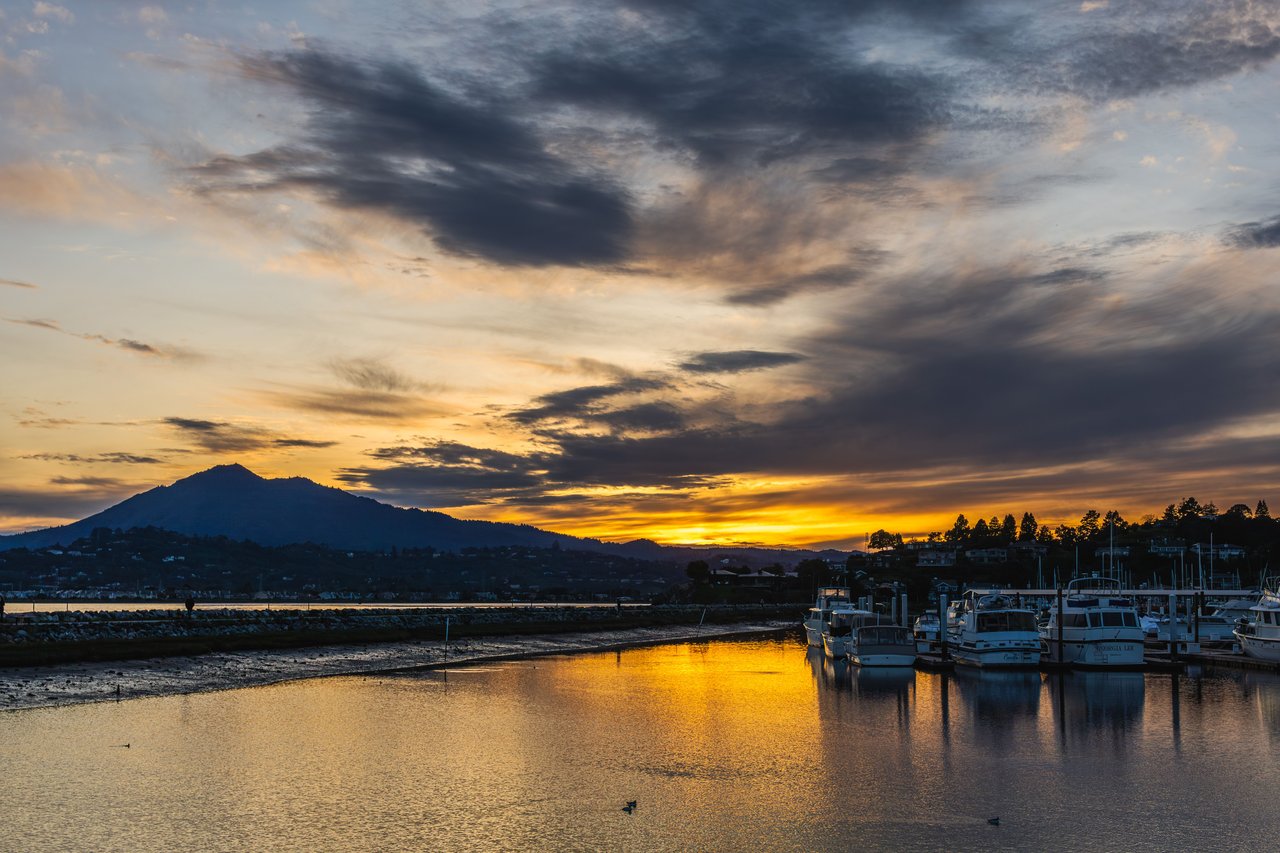
I hike Mt. Tamalpais most weeks with my dogs, and for years I carried the same story up the trail that most of Marin carries. The mountain is a sleeping maiden, the story goes, and her profile comes from a Miwok legend. It is a lovely story. It is also not a Coast Miwok story at all.
The people who named this mountain lived on its slopes and along Richardson Bay for thousands of years before Mill Valley had a sawmill, a railroad, or a single street name. I have always felt a deep honor for the ancestors of a place, the people whose care shaped the land long before any of us arrived. I have sold homes in Mill Valley since 1999, and the more I learn about who was here first, the more I see their history running quietly under the neighborhoods I know best.
The name Tamalpais is older than the Sleeping Maiden
The name Tamalpais is older than any story told about it, and it comes from the Coast Miwok, the first people of what is now Marin County. It was first written down in 1845. The most widely cited reading traces it to the Coast Miwok támal pájiṣ, usually translated as "west hill." California State Parks offers a close cousin: roughly "bay mountain" or "coast mountain."
An older theory held that the name was Spanish, Tamal país, meaning the country of the Tamal people, which is what Spanish missionaries called the Coast Miwok. Linguists have debated the details for a century. Every careful source still points back to the people who lived here.
The Sleeping Maiden came from a 1921 play
The Sleeping Maiden came from the stage, not from Coast Miwok tradition. Playwright Dan Totheroh wrote Tamalpa for the Mountain Theater in 1921, a pageant that explained the mountain's shape through an invented legend of a reclining maiden. Audiences loved it. The Mountain Play Association staged it eight times between 1921 and 1970, and by then the story had settled into local memory as if it were ancient.
It is worth knowing which stories belong to this place and which ones were written for it.
The Coast Miwok lived around Mt. Tam for thousands of years
The Coast Miwok lived around Mt. Tam for at least 5,000 years, based on carbon dating of a shell mound on De Silva Island, at the north end of today's Richardson Bay Bridge. Their territory covered all of Marin and reached north to Bodega Bay and southern Sonoma County, with more than 600 village sites identified. Estimates of the population before Spanish contact range from about 1,500 to as many as 5,000 people.
The band living around Richardson Bay, Sausalito, and Mill Valley called themselves the Huimen. Their villages of 30 to 60 people lived on clams, oysters, mussels, and fish from the bay, and on acorns, elk, and deer from the hills. The redwood canyon we now call Muir Woods sat inside Huimen homeland.
The mountain itself held a different place. To the Coast Miwok, Tamalpais was a profoundly sacred peak, revered as a spiritual guardian. Coast Miwok cultural leader Sky Road Webb has described it as the tribe's most sacred mountain, the mother of the watershed that sustained life here for thousands of years.
Anthropological records and the accounts of Coast Miwok descendants describe the high peaks as the domain of powerful spirits. Entering them without need was seen as disrespectful or dangerous, so tribal members generally did not climb to the summit. The lower slopes and surrounding valleys were different: people hunted there and gathered plants and medicine.
I understand a small part of that feeling. Early in the morning, with fog filling the canyons and the bay just starting to show, the mountain feels alive to me in a way I can't fully put into words. I don't claim the Coast Miwok's relationship with Tamalpais as my own. But I have never once walked Tam and felt it was only scenery. This land is spiritual to me, and knowing how long it was held sacred makes every hike feel even more special.
A village called Anamás stood a few blocks from downtown Mill Valley
A village called Anamás stood a few blocks from downtown Mill Valley, on Locust Avenue between Sycamore and Walnut avenues, a short walk from my office. Mission records identify it as a Huimen village. The Mill Valley Historical Society believes it was likely the birthplace, around 1781, of Huicmuse, the man later baptized Marino and remembered as Chief Marin. Marin County was named for him in 1850.
The shell mound at Anamás was enormous. When UC Berkeley archaeologists excavated it between 1907 and 1910, it measured roughly 450 feet long, 200 feet wide, and 20 feet high, built from centuries of shells, bones, and blackened hearth soil. It no longer exists. Within a few decades, that rich dark earth was hauled away for Mill Valley gardens, tennis courts, paths, driveways, and school playgrounds.
Missions and ranchos nearly erased the Huimen
Missions and ranchos nearly erased the Huimen within two generations. Juan Manuel de Ayala anchored the Spanish ship San Carlos in Richardson Bay in 1775, and his crew traded small gifts with the Huimen. By 1783, Huimen families were the first Coast Miwok to go to Mission San Francisco de Asís, and others followed from what is now Mill Valley, Belvedere, Tiburon, and Bolinas.
When the missions were secularized in 1834, their lands were divided into Mexican ranchos, and most Coast Miwok ended up laboring on them. One exception stands out. Camilo Ynitia, a Coast Miwok leader, secured the land grant for Olompali near Novato, the site of a village occupied since prehistoric times, and became one of the few Native Californians ever to hold one.
What a Mill Valley title report leaves out
What a Mill Valley title report leaves out is most of the land's history. Legal descriptions here often trace back to Rancho Saucelito or Rancho Corte Madera del Presidio, the Mexican land grants of the 1830s. Most of us treat that as the start of a property's story. It is actually the middle.
Every one of those rancho lines was drawn across land the Huimen had lived on for thousands of years. Some of the Anamás soil is probably still in Mill Valley gardens. When new clients ask me what gives this town its sense of place, I now start the answer further back.
The Coast Miwok are still here
The Coast Miwok are still here, and that part of the story is too often left out. The Federated Indians of Graton Rancheria is a federally recognized tribe of Coast Miwok and Southern Pomo people. Its rancheria was targeted for termination under the California Rancheria Act of 1958, and the tribe worked for decades to restore its status. Recognition returned on December 27, 2000, when the Graton Rancheria Restoration Act was signed into law.
The tribe's citizens trace their ancestry to a small group of survivors of the mission and settlement years. Today the tribe runs a Coast Miwok language group and has published a dictionary built from recordings of Sarah Smith-Ballard, one of the last fluent speakers. The Coast Miwok Tribal Council of Marin is another active voice in the county.
Connection to the land matters for Marin's future
Connection to the land matters for Marin's future, and I believe that more each year I live here. The Coast Miwok tended this place for thousands of years, and it was still abundant when Ayala's ship sailed into Richardson Bay. Those of us who arrived since have held it for less than two centuries.
Fire seasons, drought years, and the work of keeping Mt. Tam's watershed healthy all come back to one question: whether the people who live here see themselves as part of this land or simply living on it. I know which answer protects the mountain for the next generation. It is why I'm grateful for efforts like One Tam, the partnership of public agencies and the Golden Gate National Parks Conservancy that cares for the mountain, and why I hope every family I help settle here comes to love this ground the way I do.
Where to learn about Coast Miwok history in Marin
The best places to learn about Coast Miwok history in Marin are run by people who have spent years with it.
- Mill Valley Historical Society and the Lucretia Little History Room at the Mill Valley Public Library, for the local record of Anamás and the Huimen.
- Museum of the American Indian, Miwok Park, Novato. Founded in 1967 after park development unearthed Coast Miwok artifacts, the museum sits within the 38-acre park and offers guided walks and cultural programs.
- Olompali State Historic Park, north of Novato. The name is usually translated as "southern village" or "southern people," and the site was inhabited from as early as 6000 BC until the early 1850s. The entrance is reached from southbound Highway 101.
- Bear Valley Visitor Center, Point Reyes National Seashore. Exhibits on the Coast Miwok, with the reconstructed village of Kule Loklo nearby. Check its status before you go.
- The Federated Indians of Graton Rancheria website, for the tribe's history in its own words.
Closing
If you're considering a move to Mill Valley and want to understand a specific street beyond the listing sheet, from its flood map to the rancho line it sits on, call me at 415-609-4473 or email [email protected]. I have lived and worked in Mill Valley since 1999, and I am still learning what this ground holds.
Frequently asked questions
What does Tamalpais mean? Tamalpais comes from the Coast Miwok language. The most widely cited translation of támal pájiṣ is "west hill," and California State Parks describes it as roughly "bay mountain" or "coast mountain." The name was first recorded in 1845.
Is the Sleeping Maiden a real Coast Miwok legend? No. The Sleeping Maiden story comes from Tamalpa, a play Dan Totheroh wrote for the Mountain Theater in 1921. It was staged eight times through 1970 and became local lore, but it has no basis in Coast Miwok tradition.
Who were the first people in Mill Valley? The Huimen, a group of Coast Miwok, lived around Richardson Bay, Sausalito, and Mill Valley. Shell mounds in the area date back about 5,000 years.
Was Marin County named after a Coast Miwok man? Yes. Marin County is named for Chief Marin, born Huicmuse and later baptized Marino. The Mill Valley Historical Society believes he was likely born around 1781 at Anamás, a Huimen village in what is now Mill Valley.
Do Coast Miwok people still live in Marin? Yes. The Federated Indians of Graton Rancheria, a federally recognized tribe of Coast Miwok and Southern Pomo people, had its recognition restored on December 27, 2000. The Coast Miwok Tribal Council of Marin is also active in the county.
Can I visit Coast Miwok sites near Mt. Tam? Most of Mill Valley's shell mounds were destroyed or lie on private land, and the ones that remain are protected. The best way to learn is through the Museum of the American Indian in Novato, Olompali State Historic Park, and the Bear Valley Visitor Center at Point Reyes.
Why do some sources say Tamalpais is a Spanish name? One older theory read the name as Spanish Tamal país, "Tamal country," after the name missionaries used for the Coast Miwok. Either reading ties the name to the Coast Miwok people.
Did the Coast Miwok climb to the top of Mt. Tam? Generally not. Anthropological records and the accounts of Coast Miwok descendants describe the high peaks as the domain of powerful spirits, so people avoided the summit. They used the lower slopes and valleys for hunting and for gathering plants and medicine.